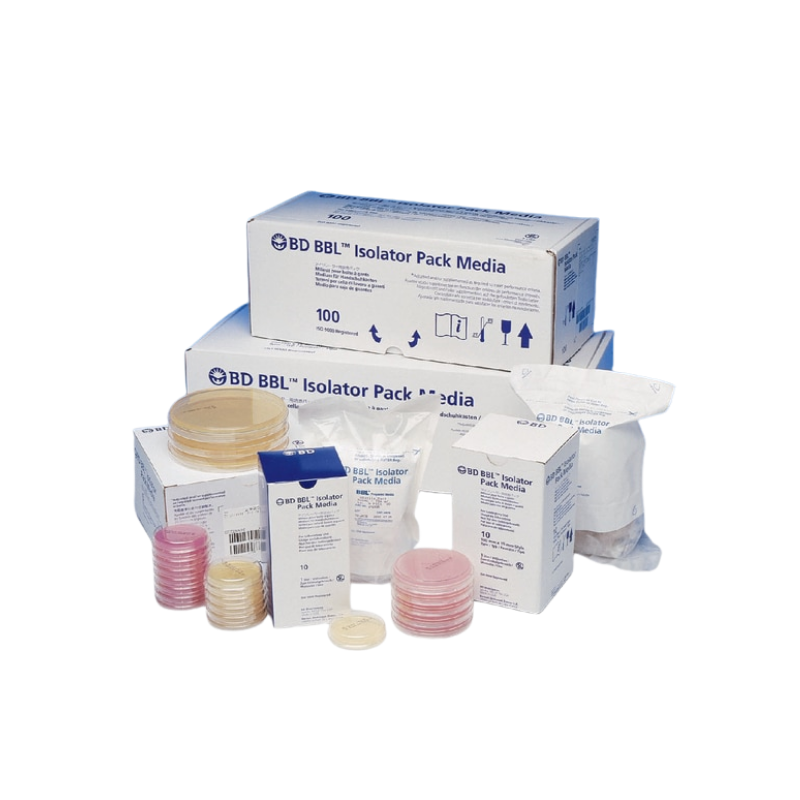
BBL™ Trypticase™ Soy Agar, with Lecithin and Polysorbate 80, RODAC™ Plate
$62.70
Secure Encrypted Checkout
Need Help?
Description
BBL™ Trypticase™ Soy Agar, with Lecithin and Polysorbate 80, RODAC™ Plate
BBL™ Trypticase™ Soy Agar (TSA) with Lecithin and Polysorbate 80 in a RODAC™ (Replicate Organism Detection and Counting) plate format is a prepared culture medium designed for environmental surface monitoring. The convex agar surface is intended for direct contact sampling of flat, nonporous areas in controlled settings such as cleanrooms, pharmaceutical and medical device manufacturing, laboratories, and healthcare environments. The medium supports the recovery of a broad range of aerobic bacteria and fungi commonly encountered on environmental surfaces while incorporating neutralizers that help reduce inhibition from residual disinfectants.
Key features
- Prepared contact plate format: Ready-to-use RODAC™ plate designed for direct surface impression sampling and colony enumeration.
- General-purpose nutrient base: TSA provides peptones and growth factors suitable for many nonfastidious microorganisms.
- Neutralization system: Lecithin and Polysorbate 80 are included to help neutralize quaternary ammonium compounds and other disinfectant residues, improving recovery of stressed organisms from sanitized surfaces.
- Standardized monitoring support: Suitable for routine trending of microbial contamination levels on equipment, work surfaces, and facility touchpoints.
Intended use
This product is intended for qualitative and quantitative assessment of microbial contamination on environmental surfaces by contact plate methodology. After sampling, plates are incubated under conditions appropriate to the monitoring program to allow growth and subsequent counting and identification as required. Results may be used to support environmental monitoring, cleaning validation activities, and ongoing hygiene assessment, in accordance with site procedures and applicable standards.
How it is used
- Label the plate and document the sampling location, area, and time.
- Remove the lid and gently press the convex agar surface onto the test area using consistent pressure and contact time.
- Replace the lid promptly to minimize contamination.
- Incubate and enumerate colonies, recording results as CFU per plate or converted to CFU per sampled area per internal procedures.
Performance considerations
Recovery can be influenced by surface texture, sampling pressure, contact time, moisture, disinfectant type and concentration, organism stress, and incubation conditions. While lecithin and polysorbate 80 improve recovery in the presence of certain residues, they may not neutralize all disinfectants or sanitizers. For rough, porous, or irregular surfaces, alternative sampling methods (e.g., swabs or sponges) may provide better recovery.
Storage and handling
Store plates as directed by the manufacturer, protected from dehydration, excessive heat, and freezing. Bring plates to room temperature before use to reduce condensation. Do not use plates that are cracked, dehydrated, contaminated, or beyond the labeled expiration date. Follow standard microbiological practices and dispose of used plates as biohazardous waste according to institutional policy.
Product summary
| Attribute | Description |
|---|---|
| Category | Agar prepared plate (contact plate) |
| Medium | Trypticase™ Soy Agar (TSA) |
| Neutralizers | Lecithin; Polysorbate 80 |
| Sampling method | Direct surface impression (RODAC™) |
| Typical application | Environmental surface monitoring and trending |
For complete instructions, incubation recommendations, and quality control guidance, consult the current product labeling and applicable laboratory procedures.


